Research output
Selected publications
A thematic selection of papers that best represents my research. The complete and up-to-date list is available on Google Scholar .
Research area
Personalisation and pragmatic language
Work on how language varies across people, social groups and communicative contexts, with particular attention to generational style and irony.
-
Can Large Language Models Personalize Dialogues to Generational Styles?
Objective: This paper examines whether LLMs can rewrite task-oriented dialogues in styles associated with Baby Boomers, Generation X, Generation Y and Generation Z while preserving the original communicative goals. It introduces P-MultiWOZ, validates the resource through automatic and human evaluation, and compares its linguistic patterns with GeMoSC, a separate corpus of generation-annotated movie dialogue, to assess whether the generated styles are recognisable and grounded in observable language variation.
-
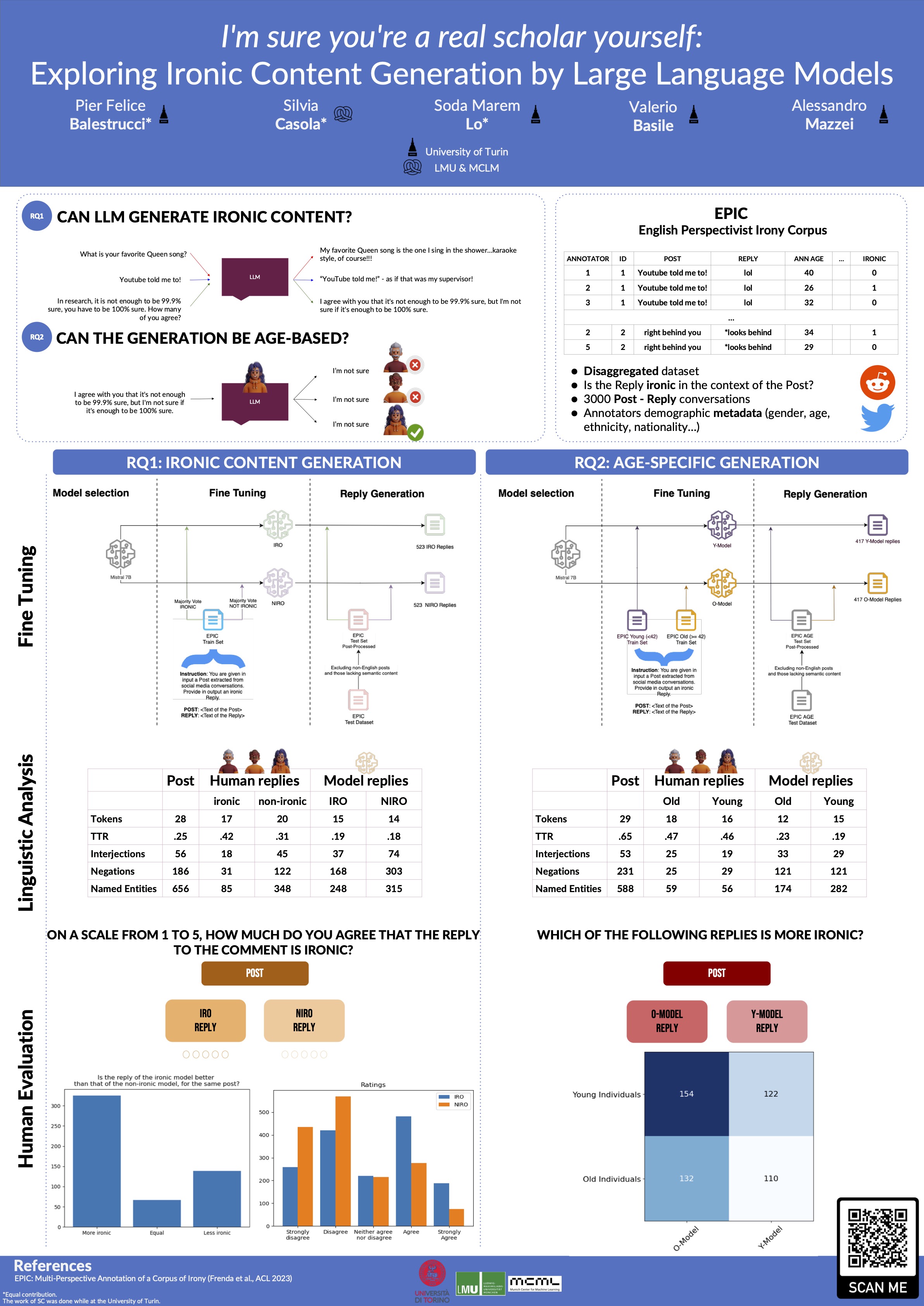
I’m Sure You’re a Real Scholar Yourself: Exploring Ironic Content Generation by Large Language Models
Objective: This study investigates whether LLMs can generate contextually appropriate ironic replies to social-media posts. It fine-tunes models for ironic and non-ironic generation, analyses how their outputs relate to the original post and to human-written replies, and evaluates them at scale with human judges. It also explores whether models can reproduce irony associated with generational perspectives, highlighting both the potential and the limitations of perspective-conditioned generation.
Research area
Accessible conversational AI
Dialogue systems, datasets and evaluation methods designed to make formal and graphical educational content more accessible to blind and visually impaired learners.
-
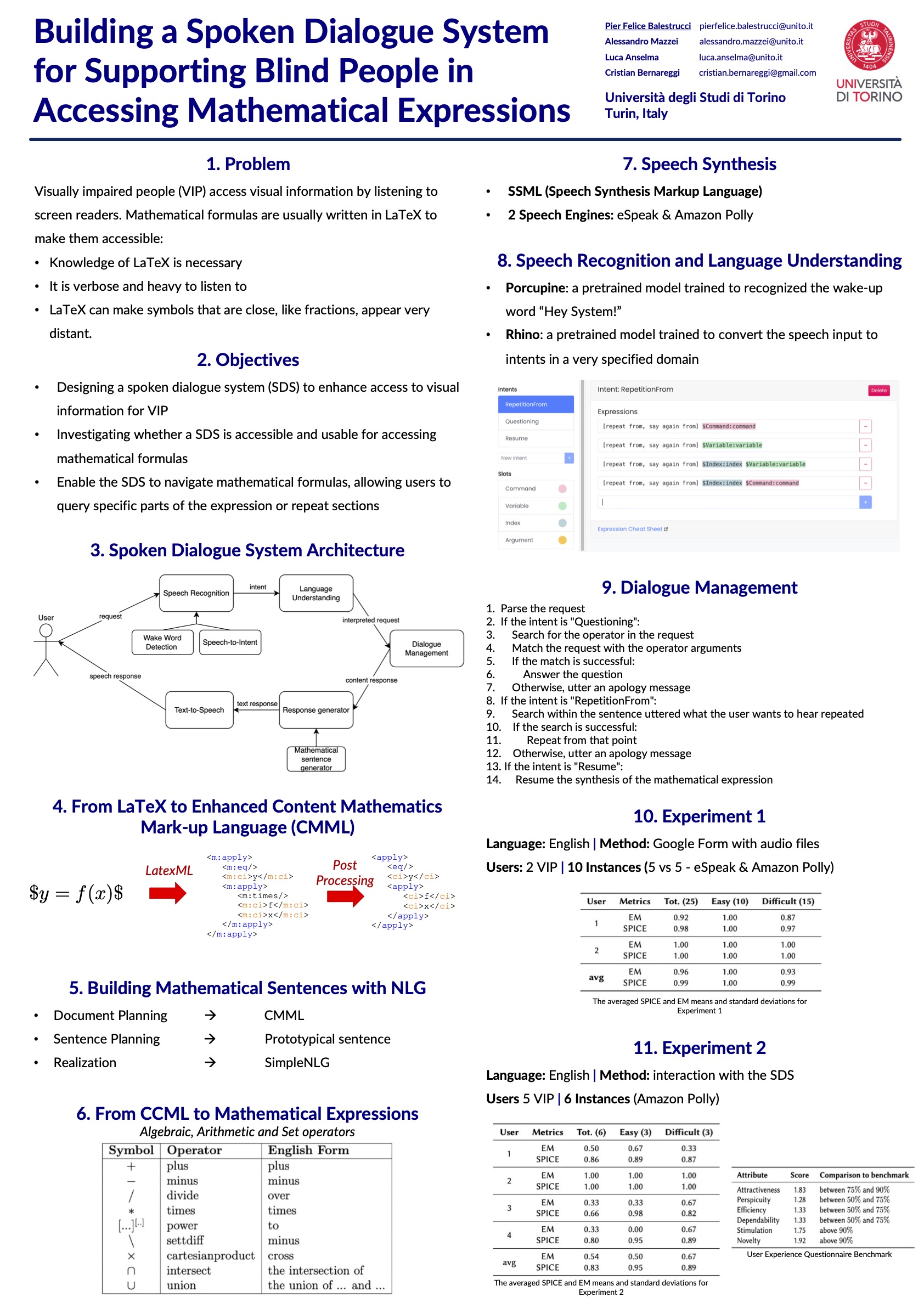
An Educational Dialogue System for Visually Impaired People
Objective: This article studies dialogue as an alternative to diagrams and tables for communicating information about finite-state automata, which can create substantial accessibility barriers for visually impaired students. It presents a rule-based educational dialogue system and evaluates it through an A/B study against standard tabular representations, measuring comprehension and user experience to determine when conversational, non-visual exploration can provide more effective access to formal structures.
-
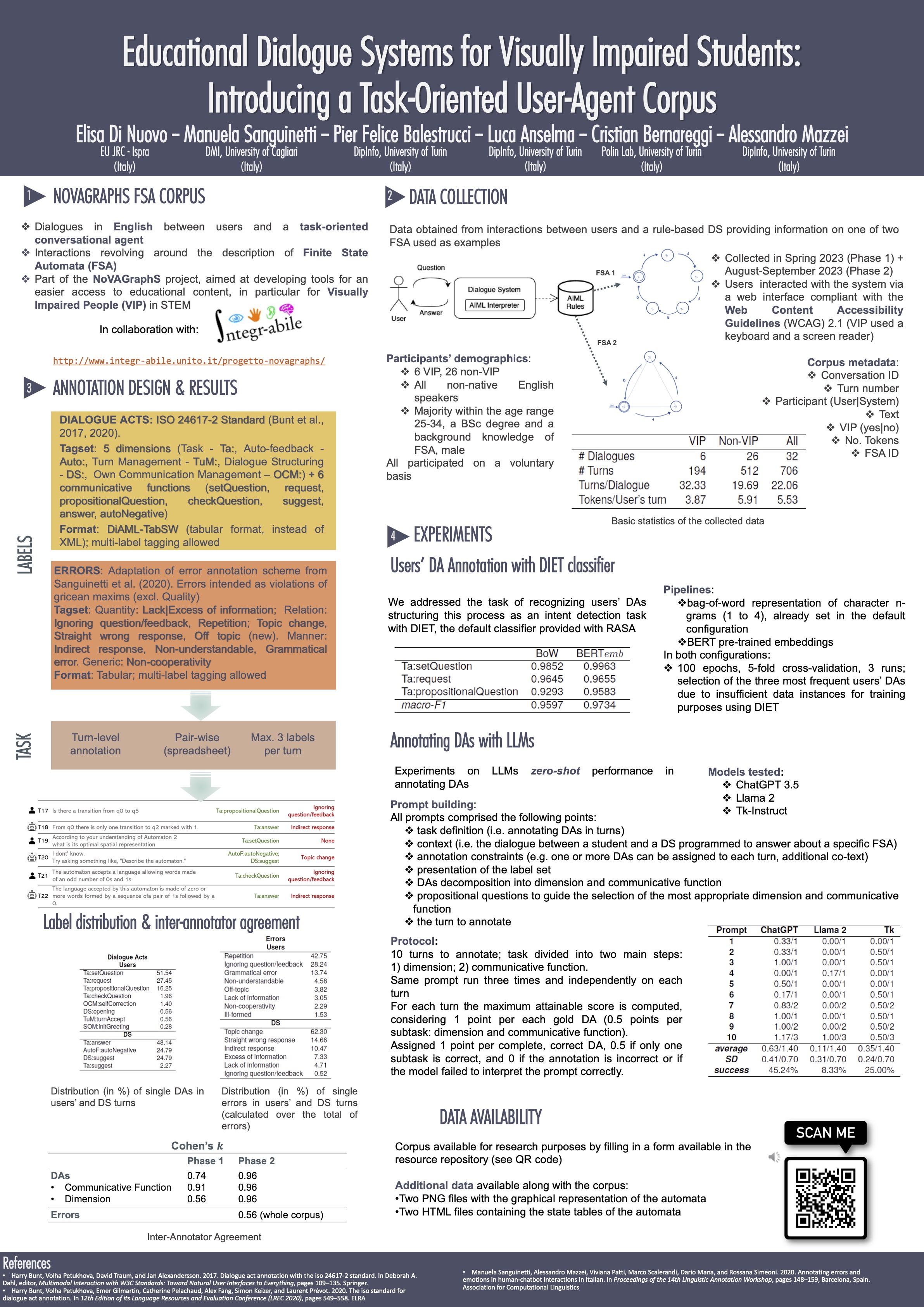
Educational Dialogue Systems for Visually Impaired Students: Introducing a Task-Oriented User-Agent Corpus
Objective: This paper introduces a corpus of real English dialogues between users and a task-oriented agent that verbally describes finite-state automata. The resource was created to support the development of accessible educational technologies for STEM content and includes interactions from both sighted and visually impaired participants, making it possible to examine differences in how the two groups communicate with the system. The work documents the data-collection methodology and annotation scheme, analyses the resulting dialogue patterns, and evaluates both supervised classification and the annotation capabilities of three large language models as a basis for future corpus expansion.
Research area
Natural language generation and structured knowledge
Resources and architectures for turning structured representations into fluent language while retaining control over content and system behaviour.
-
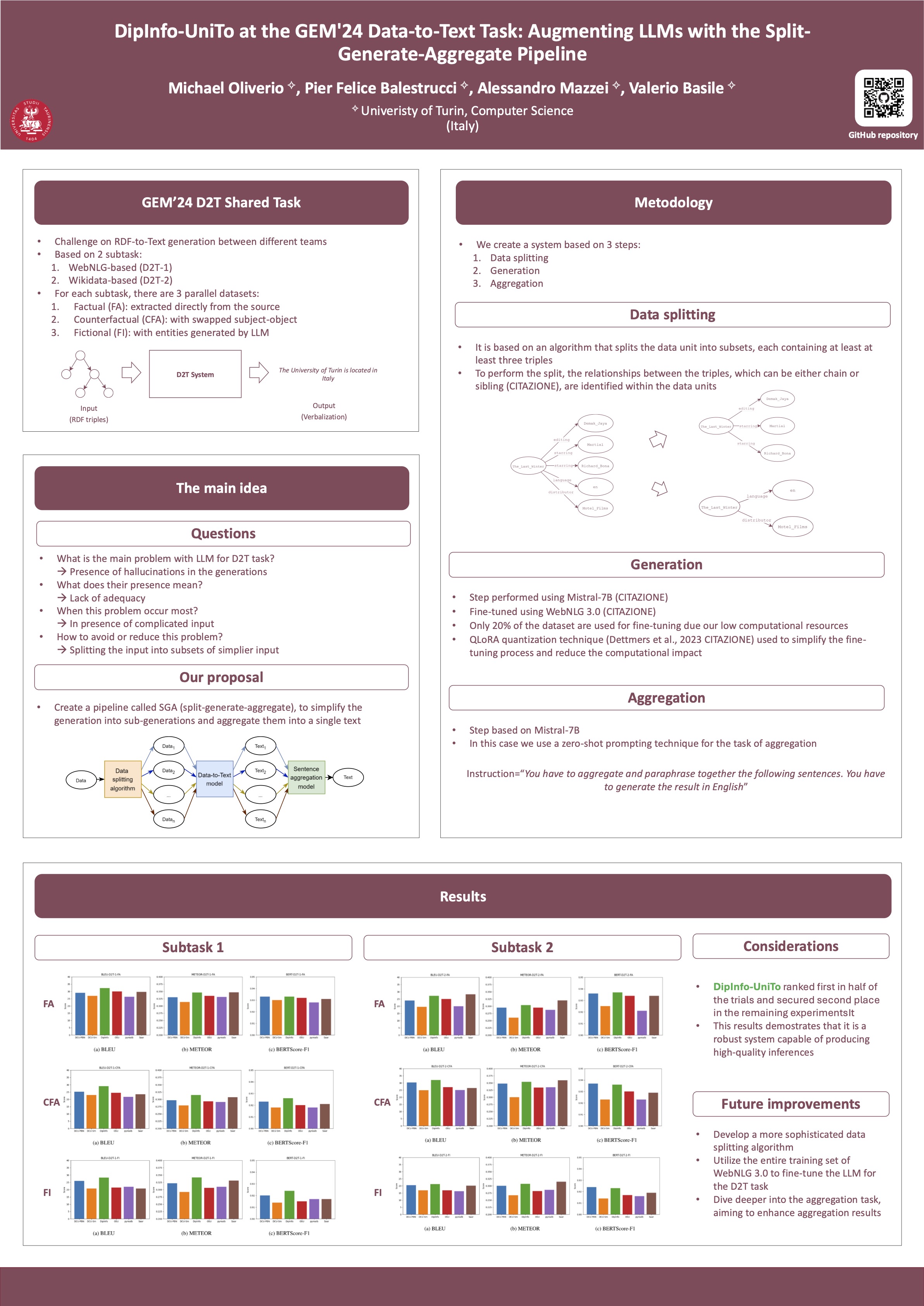
WebNLG-IT: Construction of an Aligned RDF-Italian Corpus through Machine Translation Techniques
Objective: The paper creates WebNLG-IT, the first complete Italian version of the WebNLG RDF-to-text corpus, by combining neural machine translation with a semi-automatic rule-based post-editing process. The resulting resource is used to fine-tune Italian and multilingual LLMs, compare RDF-to-text generation across Italian and English, and develop an Italian adaptation of a modular generation pipeline that verbalises semantic-web triples.
-
AIML+: Enhancing AIML for the Educational Domain Through Frames and Large Language Models
Objective: This work proposes AIML+, a framework that preserves the accessibility and authoring simplicity of AIML while extending it with frame-based natural-language understanding and LLM-supported response generation. The aim is to make educational dialogue systems more robust and scalable without abandoning explicit domain knowledge, predictable dialogue behaviour and the level of control needed when responses must remain faithful to structured educational content.
Posters